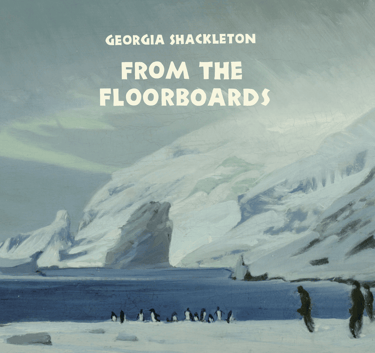
FROM THE FLOORBOARDS
A new album written on 'The Shackleton Violin' and inspired by polar history, the sea, and our changing oceans.
PRESS RELEASE - FOR IMMEDIATE RELEASE
GEORGIA SHACKLETON UNVEILS ‘FROM THE FLOORBOARDS’
A SONIC VOYAGE THROUGH HISTORY, SEA AND EXPLORATION. RELEASED FEBRUARY 27TH.
To mark 125 years since her distant cousin, Sir Ernest Shackleton set sail on the Discovery with Captain Scott, acclaimed violinist and songwriter Georgia Shackleton presents her new album From the Floorboards, alongside a live tour celebrating history, endurance, and our living seas.
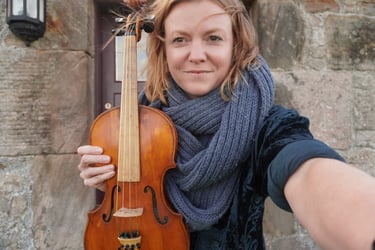
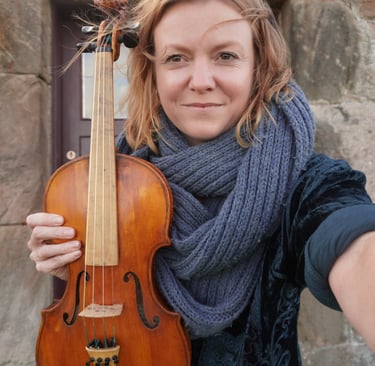
At the heart of the album is the Shackleton Violin, crafted by conservationist and luthier Steve Burnett from the floorboards of Shackleton’s former Edinburgh home. Built as a time capsule in honour of polar explorers and as a voice for our struggling seas, its resonant tones became the seed for this project. The album also features The Il Mare Violin and The Orca Viola, crafted from the same piece of driftwood, creating a family of instruments that share a singular story and voice.
All music was composed during two residencies in Scotland with these instruments, inspired by the sea, tide-soaked shores, and coastal landscapes. Recorded on location aboard the historic RRS Discovery by Aaren Bennett, and in the studio by Sam Kelly, the album was produced collaboratively by Georgia Shackleton, Sam Kelly and Aaren Bennett.
From the Floorboards blends Georgia’s unmistakably inventive and expressive songwriting with songs written by Shackleton and his crewmates aboard the relief vessel The Morning, after the Discovery became trapped in Antarctic ice. Her distinctive compositional voice sits naturally alongside this historic material, creating a seamless dialogue between past and present.
Listeners are invited to traverse icy seas, tidal shores, and hidden rockpools, encountering whales, seahorses, and the subtle dramas of the natural world. The music captures both the grandeur of human exploration and the fragile beauty of the world we inhabit today.
1. From the Floorboards
Written on the Shackleton Violin, this tune is both the namesake and starting point of the album From the Floorboards. Playing this instrument shaped the music in ways that are different from my own violin. There is a power and presence in Steve’s Shackleton Violin that inspires a distinct voice. Broad and woody in tone, it still manages brightness and punch, and the tunes I wrote on it definitely grew from its character. From the Floorboards captures the strength, warmth, and expressive possibilities of this remarkable instrument, crafted from floorboards from Sir Ernest Shackleton’s former Edinburgh home.
2. The Seahorse
The Seahorse was written as a celebration of one of the ocean’s most delicate and enchanting creatures. The song was inspired by Katherine Rundell’s The Golden Mole. I was struck by her words:
“We should wake in the morning and we should remember the seahorse and we should scream with awe and not stop screaming until we fall asleep, and the next day and the next. Each single seahorse contains enough wonder to knock the whole of humanity off its feet, if we would but pay attention”.
I hope this song captures a fraction of that sense of wonder and astonishment. There is such fragility, grace, magic, and complexity hidden in such a small being. Whilst I’ll never match the power of Katherine’s words, this song is my attempt to marvel at the small miracles of the natural world.
3. Sea Legs
A song for Sir Ernest Shackleton, written as a reflection across time from the perspective of a man who could never quite escape the call of the sea. Shackleton carried a restlessness with him that acted as both a burden and a compass, always longing for open water whenever he returned to land. There is a stillness in the closing verse, which is built around his last diary entry, written on the night he died during the Quest expedition: “A wonderful evening. In the darkening twilight I saw a lone star hover: gem-like above the bay.”
4. Engineer and the Doctorman
The Engineer and the Doctorman, originally titled Scotland Forever, was written by Shackleton and Gerald Doorly. It was decided that Shackleton return with The Morning to New Zealand owing to ill health following an arduous 95-day sledging journey undertaken with Captain Scott. On board The Morning, Shackleton struck up a friendship with two Scots: John Morrison, whom he nicknamed “MacHinery,” and George Davidson, whom he called “MacMush.” Morrison had been entertaining the mess with his conviction, inspired by H. G. Wells’s Anticipations, that only engineers and doctors were truly essential professions. The song was written to be sung, in imagination, as a duet between the two Scots, celebrating their professions with humour and pride. Since learning this song, I’ve felt a particular connection with it. Something in the text and melody echoes the way I shape my own songs, perhaps a small creative thread shared with my distant cousin, Sir Ernest Shackleton.
5. Oystercatchers / Down to the Rockpool
During my residency with the Shackleton Violin, I spent a lot of time wrapped up in my scarf, cup of tea in hand, outside my little fisherman’s cottage. I particularly enjoyed the energetic drama of a low offshore rock at rising tide, watching the oystercatchers jostle, shuffle, and call as they staked their claim on the shrinking rock. A little parliament of black, white, and red set against the brine and the surf.
Down to the Rockpool was written for one of my favourite pastimes: staring into rockpools. My fascination with these miniature worlds has never left me since childhood. During my residency in Scotland, I spent hours observing crabs scuttling at night, anemones swaying in the day, and tiny fish darting among the rocks. With a cup of tea in hand, I felt completely at peace, waiting on the ever-shifting residents of the pools. This tune celebrates their delicate, intricate lives and the quiet joy of watching them.
6. Southward
Southward is a romantic song written by John Morrison, shaped by distance, longing, and the fragile hope of returning to a love left behind at home. There’s a quiet loneliness in this song that I find moving, and slightly intrusive to sing. My adaptation draws from the melody composed by Gerald Doorly in partnership with Morrison. Morrison would sketch a line on paper to depict how he imagined the melody rising and falling, and Doorly would notate it.
7. Elephant Island / Safe Harbour
Elephant Island is a slow, free-flowing tune inspired by the perilous journey of Shackleton’s lifeboat, the James Caird, across the rolling Southern Ocean. After the Endurance was crushed by the ice, Shackleton and his men reached Elephant Island, where twelve crew members remained stranded. From there, he and five men sailed 800 nautical miles to South Georgia. A 16-day voyage through freezing seas and huge waves.
My hope is that the tune reflects the sway of the ocean and the weight of the journey. Safe Harbour follows as a steady, modal jig, offering a sense of relief and release. Though the men still had to trek across mountains to reach the whaling station, the jig mirrors the lift of spirits, the joy of reaching safety, and the hope of reunion with those left behind. Elephant Island was recorded on board the RRS Discovery using the Shackleton Violin.
8. The Ice King
The Ice King was written by John Morrison and his crew mates a week after The Morning departed from the Discovery. Captain Scott had ordered the relief vessel back to New Zealand to prevent her from becoming trapped in the ice alongside The Discovery. The “Discoverers” were left to face the long Antarctic winter, waiting for The Morning to return the following spring with fresh supplies, and the welcome company of their newfound friends. I have composed my own melody to the song.
9. Band of Mothers
Band of Mothers was inspired by the tragic 2016 stranding of sperm whales along the east coast of England. These deep-water giants found themselves in shallow seas, likely following declining prey they were drawn into the North Sea, where their sonar faltered and the familiar compass of the deep ocean failed them. Subtle shifts in the seas, magnetic anomalies, and human-made acoustic interference may have compounded their disorientation. One whale washed up at Hunstanton, Norfolk, where families passed by on New Year walks, witnessing its struggle. Others were found along Lincolnshire beaches and across Europe. This song reflects their bond, their vulnerability, and the fragile boundary between freedom and entrapment. A lament for those who never returned to the deep.
10. Happisburgh Tide
Happisburgh Tide was written for the eroding coastline of Norfolk. Happisburgh is one of the stretches most severely affected, where the sea claims homes and livelihoods year after year. The effects of climate change are starkly visible here, and this tune seeks to reflect both the power and inevitability of the tides. The ebb and flow mirrors the stages of the tide. Moments of calm, retreat, and advance. A tune written for the land, the sea, and the communities caught in between. Also present on the recording are the sea and seabirds, recorded during my residency in Scotland.
11. East Neuk
East Neuk was born during my first residency in Scotland, when I had the chance to borrow Steve’s Shackleton Violin for the very first time. I wrote it while sitting by the window of my small fisherman’s cottage on the East Neuk of Fife. Just outside the window lay a little bay, its tides and colours shifting constantly, painting a new scene every hour. I wrote this while waiting for the sea to fill my little bay for a brisk winter swim.
12. Footprints in the Snow
A tribute to the dogs who accompanied the great polar expeditions. To the men living and working in those extreme conditions, the dogs were far more than a means of transport. Their canine companions were a loyal presence in a world of ice and silence. Their strength carried supplies, and their spirit carried morale. A song for the paw prints that ran alongside the human footprints.
INSTRUMENTS & RECORDING LOCATIONS
On Board The Discovery: Elephant Island, and string parts for Ice King were recorded on board The RRS Discovery using The Shackleton Violin. Tenor Guitar for Ice King and Engineer and Doctorman was also recorded on location, on board The Discovery.
The Shackleton Violin: Engineer and The Doctorman, East Neuk, Elephant Island/Safe harbour, The Ice King, Band of Mothers, Sea Legs.
Il Mare violin: Elephant Island/Safe harbour.
The Orca Viola: Band of Mothers, Elephant Island/Safe harbour, The Ice King.
MUSICIANS
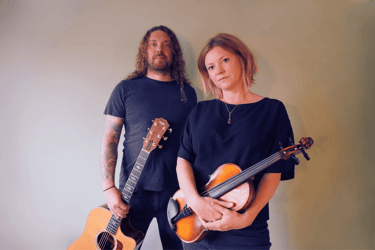
Georgia Shackleton - Vocals, fiddle, harmonium
Aaren Bennett - Guitar, tenor guitar, backing vocals
Sam Kelly - Bouzouki (Tracks 7, 11).
Nic Zuppardi - Mandolin (Tracks 1, 2)
Nick Cooke - Melodeon (Tracks 5, 6)
Christina Alden - Backing vocals (Track 2, 8, 12).
Adam Clark - Banjo (Track 12)
ALBUM RELEASE TOUR DATES
February
3 Feb – Hoy at Anchor Folk Club, Leigh-on-Sea
6 Feb – Milkmaid Folk Club, Bury St Edmunds
7 Feb – Deepdale Camping, Burnham Deepdale, Norfolk
11 Feb – Carberrys, Norwich
12 Feb – Carberrys, Norwich (sold out)
13 Feb – The Harrison, London
15 Feb – Café No.9, Sheffield
18 Feb – The Willows Folk Club, Preston
22 Feb – St Albans Folk Club, Hertfordshire
May
22 May – Norwich & Norfolk Festival, Norwich (with Q&A and words from Steve Burnett).
8th June - Folk at Yalm, Norwich
September
11 Sept – Oak Folk, Wymondham, Norfolk
16 Sept – Romford Folk Club, Essex
18 Sept – Cley Marshes Visitor Centre, North Norfolk
CONTACT
georgiaoliviashackleton@gmail.com